











































Are Children on Track with Their Routine Immunization Schedule in a Fragile and Protracted Conflict State of South Sudan? A Community-based Cross-sectional Study
London School of Hygiene and Tropical Medicine (Idris); University of Tampere (Tapkigen); New York University (Kabutaulaka); Health Pooled Fund (Ayeni, Obwoya); University of Oxford (Ayomoh)
"This study adds to the existing evidence that is useful to advance improvements of immunization uptake and coverage for children living in armed conflict settings."
Since 2012, total immunisation coverage in the conflict-prone South Sudan has been around 47.5% - far below the global recommendation of 90%. The South Sudanese civil war, which lasted between December 2013 and February 2020, has affected health-related outcomes, including immunisation timeliness. The objective of this study was to assess if children aged 0-23 months in the rural communities of the four counties in the former Western Lakes State, an area of particularly protracted conflict, were on track with their immunisation schedule and to identify predisposing factors that affected this study population's immunisation status.
The researchers conducted a community-based cross-sectional study among 428 children and their mothers/caregivers using a semi-structured questionnaire. More than three-quarters of the children surveyed (75.5%) were off track with their vaccination schedule (meaning they had not received a vaccine they were eligible for on or after 28 days of delay according to South Sudan's recommended schedule). For vaccines with more than one dose, such as pentavalent and oral polio vaccine (OPV), the proportion of children being off track with immunisation increased in subsequent immunisation doses.
In multivariable analysis, some of the findings with communication-related implications include:
- The absence of community engagement discussing immunisation importance in both the church (odds ratio (OR) 2.42, 95% confidence interval (CI) 1.16-5.01) and from the greater community (OR 3.62, 95% CI 1.42-9.18) increased the odds of children being off track with immunisation compared to communities that did engage. In other words, a child who did not attend a church that discussed immunisation importance was more than 2 times more likely to be off track with immunisation than children who went to a church that did, and a child whose community leaders did not discuss immunisation importance was more than 3 times more likely to be off track than a child whose community leader did.
- Children were up to more than 2 times more likely to be off track with immunisation when there was no vaccinator conducting outreach immunisation compared to when there was (OR 2.27, 95%; 95% CI 1.29-3.96). In other words, children without access to outreach immunisation were over 2 times more likely to be off track than children with access to outreach immunisation.
- Giving an adequate immunisation notice before conducting immunisation outreach visits to communities was also associated with reduced odds (adjusted odds ratio (AOR) = 0.27; 95% CI 0.09-0.78. p-value = 0.016) of children being off track with their immunisation. In other words, he probability of a child being off track was reduced by 85% when mothers and caregivers were given adequate notice about immunisation outreach.
- Children with an immunisation card had 71% reduced odds of being off track with their immunisation (AOR = 0.29; 95% CI 0.10-0.83, p-value = 0.021) compared to children without immunisation cards.
- Children who reside near health facilities and do not require transportation to facilities had 87% reduced odds of being off track with their immunisation compared to those who lived far and required transport to facilities. Furthermore, children who did not have vaccinators coming directly to the family livelihood/business were about 70% less likely to be on track.
The findings were further supported by the results in the multilevel multivariable logistic regression models that adjusted for potential confounders in a 3-multilevel model: maternal and child characteristics, community-related variables, and state health systems variables. For example, the chances of being off track with immunisation increased among children whose mother reported that vaccinators did not conduct outreach services (AOR 7.21, 95% CI 3.82, 13.5), and lack of discussion by the community (AOR 8.01, 95% CI 4.02, 15.92) and churches (AOR 7.62, 95% CI 3.90, 14.87) on the importance of immunisation.
The perceptions and experiences of mothers and caregivers were also seen to be an influential factor, as children were more than 4 times more likely to be off track if they had mothers who believed that the benefit of immunisation was more towards child growth than protection against disease. In addition, children who had 6 siblings or more were up to 60% less likely to be off track compared to being an only child.
The researchers note that the findings highlight, in part, the following:
- The role religious organisations play as an influential platforms for educating the public and communicating the benefits of immunisation to their worshippers - The researchers recommend review of existing policies to ensure that religious organisations are involved in the planning and implementation of immunisation programmes, as well as the monitoring of vaccine utilisation at the community level.
- The need for the active involvement of community leaders in driving immunisation programme success - This finding is corroborated by a study, cited here, that focused on community engagement, routine immunisation, and the polio legacy in Northern Nigeria, a similar conflict-context area with a long history of poor immunisation and health performance. It can be deduced that the quality and volume of immunisation information can be promoted through community leaders. In fact, the researchers deem it "imperative for community leaders to be more involved in promoting immunization education considering that in the absence of formal education facilities, community leaders can advance community health education, especially for girls and women."
- The benefit of optimising immunisation outreach and the provision of adequate notice to mothers and caregivers - As the researchers explain, in order to achieve an effective immunisation outreach programme, a micro-plan that involves rigorous communication with community stakeholders during the pre- or post-planning process should be implemented. The micro-plan should be developed in consultation with the benefiting communities and should have social mobilisation well integrated into it, as outreach activity is partially determined by the robustness of social mobilisers' commitment. Furthermore, the commitment and quality of social mobilisers should be reestablished: Immunisation programme managers should ensure they have good knowledge of the area they are to cover, feel comfortable to work in insecure areas, and are accepted by their assigned community. Social mobilisers and vaccinators providing outreach services should also be regularly supported, mentored, and monitored.
- The usefulness of a well-thought-out and coordinated vaccination plan with input from various interests, including working mothers - The study's findings imply that mothers/caregivers are likely to prioritise their businesses over the immunisation of their children when the timing of immunisation clashes with their business hours.
- The urgency of a robust implementation and coordination plan between the health facility, outreach, and mobile immunisation services to help reduce caregivers' transportation costs when seeking to keep their children on track with vaccinations.
The researchers conclude: "This study showed that a high proportion of children are off track with their immunization schedule and this is mainly driven by factors...[that] include...sub-optimal communication about immunization by religious organizations and community leaders, inadequate notice of outreach immunization to mothers/care-givers, limited reach of of outreach vaccination, the perceptions of mothers/care-givers' towards immunization, and travel distance to health facilities....The findings of this study are not likely to be transferable to a non-conflict context, nevertheless, we strongly recommend regular evaluation of the performance of health system vaccine delivery at the community level."
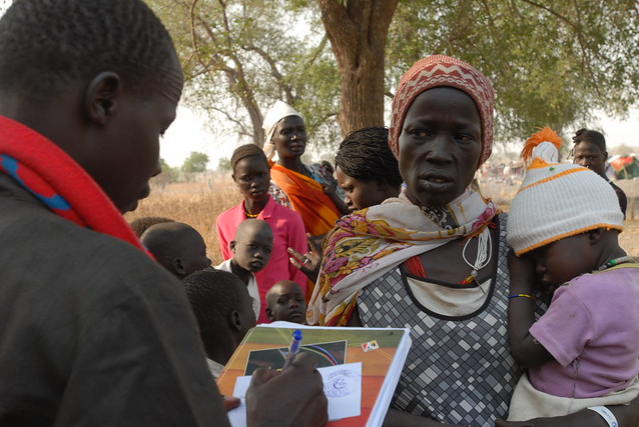
BMC Pediatrics (2022) 22:147. https://doi.org/10.1186/s12887-022-03213-5. Image caption/credit: A mother receiving a vaccination card of her child at a vaccination post in Tergol, where the Akobo river marks the border between South Sudan and Ethiopia. ©UNICEF Ethiopia/2014/Bizuwerk via Flickr (CC BY-NC-ND 2.0) )
- Log in to post comments