










































The Arab World Online: Trends in Internet Usage in the Arab Region
Dubai School of Government
"[T]he internet is re-shaping societies and economies in the Arab region in new ways."
This white paper examines trends across four dimensions of internet usage in the Arab world:
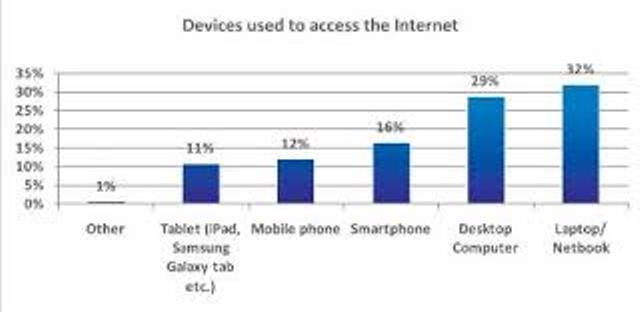
- "Access to the internet and internet-enabled devices,
- Quality and quantity of time spent online,
- Frequency of internet usage,
- Attitudes and trends toward social media."
[Footnotes have been removed by the editor.]
Due to the fact that the Arab region has more than 125 million users, with 53 million of them using social media, the internet is reaching into communication, social, and economic sectors of the region. As stated here, by making "hard-to-find data" accessible, the media, education, music, entertainment, software, and publishing industries are being transformed, as are relations with consumers. e-Government services are now facilitating service delivery by treating citizens as customers who can bypass traditional bureaucracy, and government sectors can collaborate and communicate internally through the internet.
However, "the digital divide remains a significant barrier for many people. In many parts of the Arab world levels of educational attainment, economic activity, standards of living and internet costs still determine a person’s access to life-changing technology." Network penetration is growing at a rate of 30% annually. "In 2012, Countries like the UAE [United Arab Emirates], Bahrain, Qatar and Kuwait achieved penetration rates above 50 percent, while on average regional penetration rates stood around 28 percent. Though countries like Morocco, Sudan and Yemen have some of the lowest penetration rates in the region, they also had some of the highest growth rates in the region."
Findings are presented in graphs from data collected in field surveys of 22 Arab countries. 76% of the sample was male, and 48% of the sample was between the age of 15-29. Amongst the statements evaluated by survey participants and statistics obtained, for example, are the following:
- The internet poses a threat to my privacy: 10% strongly agree, 25% agree, 34% neutral, 27% disagree...
- Online communication replaced traditional communication: 26% strongly agree, 45% agree, 20% neutral, 7% disagree, strongly disagree 1%...
- What is your primary source of news? 36 % online sources and portals, 28% social media sources, 28 % traditional sources, 6% word of mouth, 2% other...
- Time spent reading online educational blogs and magazines: 25% daily, 24% several times a week, 17% several times a day, 12% at least once every two weeks, 7% once a month, 6% less often...."
New Publications at the CAMECO Library July - December 2013 at the Catholic Media Council (CAMECO) website, April 7 2014.
- Log in to post comments