










































Ahmadu Bello University - Masters Degree in Development Communication
A major thrust of the ABU programme is its development theatre and development communication courses which begin at the undergraduate level and run up to the postgraduate or graduate levels. This programme is recognised globally for its unique focus on theatre and development. The development communication course grew out of years of fieldwork, research, and teaching. It used to be taught as part of the Community Theatre, Media Arts, Theatre for Development, Cultural Studies courses and was then developed into a separate areas of study.
Masters candidates must take a minimum of 60 credit units of courses to graduate. In addition to core and elective courses, candidates must present two seminar papers which will earn them 2 credit points, as well as submit a thesis for 10 credit points. The course is offered full-time over two years.
The following are the courses offered over two semesters:
First Semester
- Cultural Studies - This course examines various theories, dimensions, and appearances of culture and its construction by peoples in different contexts.
- Practicum I - In the first semester this course will focus on hands-on training in television, video/film production.
- Field School - this is a practical field study experience in which students will be exposed to development contexts needing intervention. Students will be required to respond to that context which, as much as possible, will be unfamiliar. The field school can happen anywhere in Africa.
- Communication, Media and Society - This course explores the relationship between communication, media and society and offers the opportunity to critique media and communication practices in a range of contexts.
- Community Development and Development Implementation - Students will go through practical processes of community development taking into consideration planning, community involvement, project design, and implementation processes in various contexts. This will feed into the practical project with actual community members in the second semester where the students are required to carry out community development work in communities of their choice.
- Development and Participatory Communication Theories - This course examines the meaning of development and participatory communication and the theories that inform the practices. The theories and models of development and participatory communication will be examined critically to determine their efficacy or weaknesses and how they inform the practice of communicating development.
- Statistics for Development Communication - This course introduces students to the basics and processes of statistics and statistical analysis. The aim is to prepare students for research and the generation and analysis of statistical data concerning development and participatory communication particularly.
- Theories of Development - This course examines the theories and concepts of development and its relationship with theatre and performance, communication and society.
- Agricultural Communication - This course will introduce students to the basics of agriculture. Most of the course will be devoted to turning agricultural information into communication products for rural audiences in Nigeria.
- Gender Communication - This course explores the gender dimension in communication for development in the African context and focuses on strategies for mainstreaming gender in development communication.
Second Semester
- Theatre For Development - This course will offer a critical and detailed look at theatre for development campaigns in a variety of contexts.
- Practicum II – This practicum will focus on radio production, photography, and new media communication design.
- Participatory Learning and Action - this will cover techniques of participatory approaches to development, action research, and participatory research techniques for community animation and action.
- Radio, Video and Television for Development - This course explores ways of using the electronic media for development purposes.
- Behaviour Change Communication Design for Development - This course begins with an introduction to psychology and then moves on to a practical hands-on approach to designing and applying information, education and communication (IEC) tools for development.
- Research Methodology - This course introduces students to research processes especially those related to humanities, including the various ways of conducting research, designing and managing research projects, as well as research analysis and reporting.
- Health Communication - This course introduces students to the basics of health, especially preventive health, in order to produce health communication products for audiences in Nigeria.
- New Media for Development - This course explores the various new media technologies and how they can be deployed for communicating development.
Click here for more information.
The teaching process includes lectures, seminars by students who are required to present seminars for peer assessment, as well as workshops for more practical areas of study. Overall, the department encourages participatory learning, a hands-on learning method, which does not view the learner as a tabula rasa (blank slate) but works on the principle that students can generate and contribute knowledge that can then be moderated by the teacher.
Students are required to take examinations for courses that have theoretical components. Continual assessments, which compliment examinations and practical assessments, take place in the form of essays, research papers, seminar presentations, tests, oral discussions, and peer assessments. Practical courses, such as television and radio production courses, do not require formal examinations and will only be assessed via "practical assessments" done according to set criteria.
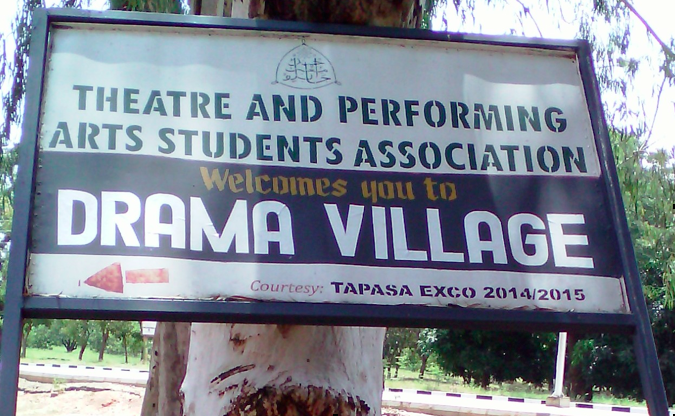
Development Communication students are required to carry out community development training for community-based organisations around Zaria or within the University’s catchment area. They are required to design and develop training modules that can be applied within communities. The Department has hired an Extension and Liaison Officer responsible for linking and organising the community groups for this and other similar exercises. The groups are either brought into the Drama Village for the training or if required, the students will go into the communities for the training exercise.
Click here to view publications by Mohammed Umar-Buratai, Professor and Head of Department.
The following are faculty members related to this Masters Degree:
Mohammed Umar-Buratai, BA, MA, PhD - Professor and Head of Department
Oga Steve Abah, BA, MA, PhD - Professor
Mohammed Salihu Bappa, BA., MA. - Senior Lecturer
Bello Bankole, BA., MLS., Cert – Senior Lecturer
Shola Adeyanju, Bsc., Msc., PhD - Senior Lecturer
A Salau, Bsc., Msc., PhD - Senior Lecturer
Steve Y. Daniel, BA., MA. - Senior Lecturer
Muhammad Rabiu Isah, BA., MA. - Lecturer
Sadik Balewa, BA, MA – Senior Lecturer
Emmanuel T Gana, BA., MA. - Assistant Lecturer
Dangoji Sylvanus, BA., MA. - Lecturer II
Umaru A. Pateh, BS., MS., PhD – Visiting Professor
Danjuma Gambo, BS., MS., PhD - Visiting Professor
Victor Aluma-Ayedun, BA., MA., PhD - Visiting Profesor
Olu Obafemi, BA., MA., PhD - Visiting Professor
Mohammed O. Bhadmus, BA., MA., PhD - Visiting Professor
Click here for more information.
Background Information:
The Theatre and Performing Arts Department was created in June 2006. The programme was formerly called Drama when it existed as a sub-unit under the Department of English and Drama, a status that the programme maintained for 31 years before it became a full-fledged department.
The Department of Theatre and Performing Arts has the following objectives:
- To produce self-reliant skilled individuals who can earn a living on their own and generate employment for others.
- To produce researchers and curators of Nigerian cultural forms for documentation and revival.
- To produce well-rounded graduates that can fit into public services in administration, personnel, advertising and public relations, broadcasting, film/video production, and teaching.
- To produce researchers and scholars in the field of Nigerian and African performance traditions and theatre.
- To produce individuals who can use theatre as a method of social investigation and communication and as a means of finding solutions to development problems.
- To produce graduates who will be equipped to do social and development work under any situation.
- To produce graduates who will contribute to the literary development of Nigeria by writing plays, books, and critical works.
Click here for more information.
Comments

Course contents
I appreciate the structure of the course and it contents. However, I want to inquire if there is or will be a subject that will reflect on these two, 1. Symbols in Communication, and 2. Risk Communication.
These are my personal views. Thank you

More details please
Dear sir, I would like tio get details of Ahmadu Bello University - Masters Degree in Development Communication,therefore request you to kindly forward relevent information or link and oblige. Thanks. Kalyan
- Log in to post comments